

Upper Secondary G3
Information on Upper Secondary Elective Subjects G3
Literature in English
Humanities
Social Studies
History
Geography
Principles of Accounts
Additional Mathematics
Sciences
Art
Design & Technology
Click here to return
Literature in English
“Literature makes us better thinkers. It moves us to see the multi-sidedness
of situations and therefore expands the breath of our own visions, moving
us towards dreams and solutions we might not otherwise have imagined.”
– Judith Langer, Envisioning Literature
Literature is essentially the study of human relationships and how we,
as human beings, need to understand and work together to create a better
place to live rather than exist. To be concise, it is how to understand
humans better. It affords us PERSPECTIVES about architecture, about politics,
about family, about all that is about humans, their living, their endeavours,
their success, their tragedy, and most of all, the fragility of Life. It
is a challenging discipline because it is about OUR opinion and not just
the opinion of the writer.
In this discipline, students learn to appreciate words and their power
from the texts which range from classics, such as Shakespeare to modern
works. Students read and respond to a variety of literary texts from the
genres of prose, poetry and drama. The greatest value of Literature is
that it promotes empathy as it develops in the student a greater understanding
of the human condition.
The student, if he/she decides to opt for this subject, sits for a 2-year
programme from Sec 3 to Sec 4. They will read two set texts - one play
and one novel and study a variety of poetry texts from Singapore writers
as well as international ones.
So why should your child take up Pure Literature?
-
Students develop a sense of individuality and creativity as they form their own opinions about issues in the texts.
-
Students develop the skills to convince others of their perspectives and interpretations, based on sound reasoning with evidence.
-
Students learn to appreciate that life is not always clear-cut, in black and white. It prepares them for the ambiguities of life and to take uncertainties in their stride.
-
Students explore texts that give them many opportunities to discuss and reassess their own values and beliefs. These act as a compass in life as they grow up.
Assessment Criteria for Literature in English
|
Paper |
Description |
Duration |
Weighting |
Components |
|
Paper 1 |
Set Text – Novel (25 marks)
Unseen – Poetry (25 marks) |
1 hour 40 mins |
50% |
Section A: Prose [25%] one passage-based question and two essay questions will be set based on the set text. Candidates will answer one of the questions.
Section B: Unseen Poetry [25%] There will be a choice of two unseen poems. Candidates will answer questions for ONE of the two poems. |
|
Paper 2 |
Set Text - Play |
1 hour 30 mins |
50% |
One passage-based question and two essay questions will be set.
Candidates will answer the compulsory passage-based question and one essay question on the selected text. Each question is 25% of the total weighting. |
Go to the top
Humanities
Upper Secondary students must read at least one Humanities subject. If
the student is reading only one Humanities subject, he MUST take ‘Humanities’,
comprising a compulsory Social Studies component (SS) and an Elective component.
In PRSS, the options for the Elective component are Elective History (EHist),
Elective Geography (EGeo) and Elective Literature (Elit).
G3 students may opt to read an additional Pure Humanities subject which
is not his or her Elective component in the compulsory Humanities subject.
For example, a student who is reading Humanities (SS/History) can choose
to read Pure Geography or English Literature. He is not allowed to read
Pure History as this would overlap with the Elective History which he is
already reading.
|
Choices
|
Humanities
|
Additional Pure Humanities courses offered in PRSS |
|---|---|---|
|
1 |
Humanities (Social Studies & Elective Geography) |
Pure History or English Literature |
|
2 |
Humanities (Social Studies & Elective Geography) |
Pure Geography or English Literature |
*only advisable for students strong in all 3 subjects; English, Geography and History, in lower secondary
Go to the top
Social Studies
Social Studies is the compulsory half of the Humanities
subject.
At the heart of the Social Studies Curriculum is the preparation of students
to be citizens of tomorrow by helping them to better understand the interconnectedness of Singapore and the world they live in,
and appreciate the complexities of the human world. Drawing
on aspects of society that are of meaning and interest to the students,
Social Studies seeks to ignite students’ curiosity to inquire into real-world issues that concern their lives.
Through inquiry and authentic learning experiences, Social Studies helps
students to attain relevant knowledge and understanding about these issues,
develop critical and reflective thinking skills, and appreciate multiple
perspectives. Social Studies seeks to inculcate in students a deeper understanding
of the values that define the Singapore society, nurture dispositions that
will inspire them to show concern for the society and the world they live
in, and demonstrate empathy in their relationships with others. The Curriculum
therefore envisions students as informed, concerned and participative citizens,
competent in decision-making with an impassioned spirit to contribute responsibly
to the society and world they live in.
Go to the top
History
History education in Singapore seeks to develop in students an appreciation
of past human experiences, critical awareness of the nature of historical
knowledge, and the ability to make connections between the past and present.
In recent years, there has been greater cognizance that historical content
and concepts as well as the accompanying historical skills, are important.
These lie at the heart of thinking critically about the nature of historical
knowledge, which is essential to make better sense of the past. History
also plays a critical role in developing students’ own identities through
an understanding of history at the personal, national and international
levels. The learning of history should spark their curiosity and inspire
them with the beliefs, decisions and dilemmas of people in the past. Through
historical inquiry, students pose questions about the present by engaging
with the past and thus draw connections between both.
The Upper Secondary History syllabuses seek to enable students to be effective
citizens and participants in the 21st century. To achieve this, students
need to understand how the present world system came into being, and the
inter-connectedness of nation-states and peoples. The curriculum also seek
to examine the key forces and developments which have shaped international
history in the 19th and 20th centuries. Through this syllabus, history
students will understand not just concepts such as balance of power, hegemony,
geopolitics and nationalism, but also acquire historical thinking skills.
Pure History students will cover the syllabus in greater depth, comprising
the following units:
-
Extension of European control in Southeast Asia and challenges to European dominance, 1870s - 1942
-
Developments in the post-World War II world: The Cold War and decolonisation in Southeast Asia, 1940s - 1991
Students reading Elective History will only cover the following unit:
-
The Making of the 20th Century Modern World, 1910s–1991.
Go to the top
Geography
Geography emphasises the integrative study of physical and human environments
to enable students to gain better understanding of their own space and
other parts of the world. It also focuses on the interconnectedness among
groups of people, and between people and their environment.
Generally, in both Pure Geography and Elective Geography, students will
be taught skills of gathering and analysing information to understand and
explain physical and human phenomena, and other contemporary environmental
and social issues that occur in different places and cultures by
-
interpreting and recognising patterns in geographical data and deduce relationships
-
organise and present geographic information in a coherent way
-
analyse, evaluate and synthesise geographical data to make informed and sound decisions.
The objective is to develop an inquiring mind to seek answers to issues
affecting our lives and the world we live in, and prepared students for
their roles as informed citizens in the 21st century and most importantly,
inculcate an awareness of appropriate attitudes and values that promotes
a positive geographical future; one that ensures the sustainability of
our resources, people, country, and planet.
Pure Geography students will cover the syllabus in greater depth, comprising
all the following:
|
Cluster 1 |
Geography in Everyday Life |
|---|---|
|
Topics |
1. Thinking Geographically
|
|
Cluster 2 |
Tourism |
|
Topics |
1. Tourism Activity
|
|
Cluster 3 |
Climate |
|
Topics |
1. Weather and Climate
|
|
Cluster 4 |
Tectonics |
|
Topics |
1. Plate Tectonics
|
|
Cluster 5 |
Singapore |
|
Topics |
1. Small Island City-State
|
Students reading Elective Geography (O-Level) will NOT cover Clusters
4 and 5.
Assessment Criteria for Humanities
We offer Pure Humanities (History, Geography) and Humanities (SS/Hist,
SS/Geog). Humanities (SS/Hist, SS/Geog) is compulsory for ALL G3 and G2
students. The following table shows a summary of the O and N-Level Assessment
components.
|
Assessment Components |
Pure Humanities (O-Level) |
Humanities (Compulsory) (O and N-Level) |
|
Paper 1
Paper 2 |
History
Extension of European control in Southeast Asia and challenges to European dominance, 1870s - 1942 - (50%) (1h 50m)
Section A: Source-based case study (5 sub-questions) – 30m
Section B: Structured Essay Question (do 1 out of 2; 2 sub-questions) – 20m
Developments in the post-World War II world: The Cold War and decolonisation in Southeast Asia, 1940s - 1991 - (50%) (1h 50m)
Section A: Source-based case study (5 sub-questions) – 30m
Section B: Structured Essay Question (do 2 out of 3 questions) – 20m
|
Humanities (SS/Elect Hist)
Social Studies - (50%) (1h 45m)
Section A: Source-based case study (5 sub-questions) – 35m
Section B: Structured Response Question (2 sub-questions) – 15m
Elective History - The Making of the 20th Century Modern World, 1910s–1991. (50%)(1h 50m)
Section A: Source-based case study (5 sub-questions) – 30m
Section B: Structured Essay Question (do 2 out of 3) – 20m
|
|
Paper 1
Paper 2 |
Geography
Geographical Inquiry, Tourism and Climate - (50%) (1h 45m)
Question 1: Geography Inquiry (20m) Question 2: Tourism (15m) Question 3: Climate (15m) Each structured question will consist of no more than 9 sub-parts. Students will be required to answer one 9-mark essay in either Question 2 or 3.
Geography in Everyday Life, Tectonics, Singapore - (50%) (1h 45m)
Question 1: Geography in Everyday Life (15m) Question 2: Tectonics (15m) Question 3: Singapore (20m)
Each structured question will consist of no more than 9 sub-parts. Students will be required to answer one 9-mark essay in either Question 2 or 3.
|
Humanities (SS/Elect Geog)
Paper 1 Social Studies - (50%) (1h 45m)
Section A: Source-based case study (5 sub-questions) – 35m
Section B: Structured Response Questions (2 sub-questions) – 15m
Elective Geography - Geography in Everyday Life, Tourism, Climate - (50%) (1h 40m)
Section A Question 1: Geography in Everyday Life (14m) Question 2: Tourism (18m)
Section B Question 3: Climate (18m)
Each structured question will consist of no more than 9 sub-parts. Students will be required to answer one 9-mark essay in either Question 2 or 3.
|
Go to the top
Principles of Accounts
Principles of Accounts is offered as an elective subject at Secondary
Three and examinable at the GCE O-Level and N(A)-Level.
Principles of Accounts is designed to designed to teach age-appropriate
and relevant accounting knowledge, skills and values. In addition, students
will understand how businesses use accounting and non-accounting information
to make decisions. Through the subject, they will acquire transferrable
skills that they can apply in their daily lives.
Student Outcomes
The syllabus intends to develop in students the knowledge and skills to
prepare, communicate and use both accounting information and non-accounting
information related to the business to make decisions.
The subject aims to first equip students with the basic knowledge and
skills on how to prepare and present accounting information and communicate
them in a useful manner that can be understood by others.
Students will be able to understand
-
what business decisions are
-
how decisions are made using accounting information
-
the limitations of relying only on accounting information; and
-
the consideration of non-accounting business-related information.
Students will be able to develop knowledge and understanding of:
-
role of accountants and the ethical values desired in the people who prepare the information
-
purpose of accounting as providing accounting information to support and facilitate decision-making
-
consideration of accounting and non-accounting information in decision-making
-
use of financial ratios for evaluation of profitability, liquidity and efficiency of inventory management and trade receivables management
-
basic forms of business entities
-
elements of the financial statements as representation of business activities and how they are presented on Financial Statements
-
principles underlying accounting as a measurement system
-
accounting information system and accounting cycle, and the double-entry recording method in maintaining records of business activities
-
internal controls to ensure accuracy of information.
Students will be able to develop the skills of:
-
apply the double entry system of recording business transactions
-
synthesis and presentation skills in the preparation of accounting information in a suitable form
-
analytical skill in interpreting financial statements and analysing the effects of business transactions and accounting adjustments on financial statements
-
evaluative skill in evaluating businesses for their profitability, liquidity and efficiency of inventory and trade receivables management using financial information and ratios
-
decision-making skill in evaluating choices using both accounting and non-accounting information.
Relevant Courses in Poly
Diploma in Accountancy
Diploma in International Business
Diploma in Bank and Finance
Diploma in Business Studies
Diploma in Business Information Technology
Diploma in Tourism and Resort Management
Diploma in International Logistic and Supply Chain Management
Assessment Criteria for POA
|
Level / Stream |
Duration |
Format |
Marks Allocation |
|
Sec 4 Express and Sec 5 Normal (A) |
1 hour |
Paper 1 Answer 3 to 4 compulsory structured questions |
40 marks (40%) |
|
2 hours |
Paper 2 Answer 4 compulsory structured questions. • One question requires the preparation of financial statements for a business for one financial year. (20 marks) • A scenario-based question (7 marks) will be part of one of the 3 remaining questions. |
60 marks (60%) |
Go to the top
Additional Mathematics
The syllabus prepares students adequately for A-Level H2 Mathematics,
where a strong foundation in algebraic manipulation skills and mathematical
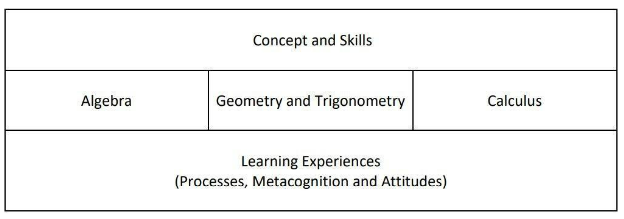
reasoning skills are required. The content is organised into three strands,
namely, Algebra, Geometry and Trigonometry, and Calculus. Besides conceptual
understanding and skill proficiency explicated in the content strands,
important mathematical processes such as reasoning, communication and application
(including the use of models) are also emphasised and assessed. The O-Level
Additional Mathematics syllabus assumes knowledge of O-Level Mathematics
At Secondary 3, students who are interested in mathematics and are more
mathematically inclined can take up Additional Mathematics which provides
greater breadth and depth of coverage of mathematics topics. The Additional
Mathematics syllabuses introduce students to Calculus and Trigonometry
besides extending the learning in Algebra and Geometry from the O-Level
Mathematics syllabus. Students are also engaged in writing proofs in Geometry
in Additional Mathematics.
The O-Level Additional Mathematics syllabus aims to enable students who
have an aptitude and interest in mathematics to:
-
acquire mathematical concepts and skills for higher studies in mathematics and to support learning in the other subjects, with emphasis in the sciences, but not limited to the sciences
-
develop thinking, reasoning, communication, application and metacognitive skills through a mathematical approach to problem-solving
-
connect ideas within mathematics and between mathematics and the sciences through applications of mathematics; and
-
appreciate the abstract nature and power of mathematics
The table below shows the difference between Mathematics and Additional
Mathematics:
|
Mathematics |
Additional Mathematics |
|---|---|
|
Relates easily to real life e.g., interest rates, speed, time, area etc. |
More abstract e.g., Proofs, Binomial Expansion, maximum/minimum areas etc. |
|
Questions involving direct application of formula
|
Questions require more analysis and making connections across topics e.g., gradient is given in the form of an expression in x, find the equation of curve |
|
Similar to Sec 2 Mathematics
|
Build on the foundation in Sec 2 Mathematics
|
Requirements to take up Additional Mathematics at Sec 3:
-
Good performance in marks
-
G3: A good pass in Sec 2 Mathematics
-
-
Algebra proficiency
-
Interest, diligence, determination, self-directedness and constant regular practice to succeed is essential
Implication on admission requirement for post-secondary studies
Junior College
-
Students taking science course will likely take up H2 Mathematics and taking Additional Mathematics in upper secondary education will prepare the students adequately
-
Students taking art course will likely take up H1 Mathematics and taking Mathematics only will prepare the students adequately
-
Individual JCs set their own admission requirements
Polytechnic
-
Admission requirements are course – dependent
-
O-Level Mathematics would be adequate
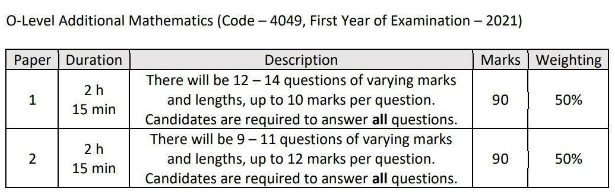
Assessment Criteria for Additional Mathematics for G3 and G2
Go to the top
Sciences
We offer Pure Sciences (Physics, Chemistry, Biology) and Combined Science
(Science (Physics, Chemistry) and Science (Chemistry, Biology)). The following
table shows a summary of the O-Level Assessment criteria.
|
Assessment Components |
Pure Science |
Combined Science |
|
Theory Papers Paper 1 |
This paper consists of 40 compulsory multiple-choice items.
|
40 compulsory multiple-choice questions, evenly split (20 questions per
Science component).
|
|
Paper 2 (Pure Science) Paper 2/3/4 (Combined Science)
|
This paper consists of two sections.
Section A will carry 70 marks and will contain compulsory structured questions (includes an 8–12 mark data-based question).
|
Consists of one paper of 65 marks per science component.
Each paper consists of two sections.
Section A will carry 55 marks and will contain a number of compulsory structured questions. The last question will carry 10 marks.
Section B will carry 10 marks and will contain two questions. Candidates must answer only one out of these two questions. |
Pure Science subjects are relatively demanding in terms of breadth and
depth compared to combined Science. For pure science, students need to
be passionate about the subject, be analytical and enjoy in-depth learning.
For instance, students need to study and understand relationships e.g.,
interpret data and graphs and be focused, precise and detailed in their
reasoning.
We would like to encourage our students to take Physics and Chemistry
or Science (Physics, Chemistry) as these subjects are meant to lay a strong
foundation for science at the secondary level. However, students who are
excited to further explore the fascinating study of life (e.g. curious
to find out how our bodies work and how plants function) may consider reading
Biology or Science (Biology). A good command of the English Language is
essential for students who are interested in taking Biology as the subject
involves a lot of writing.
Students should consider their learning ability, interest and aspiration
when choosing subjects. It is important for students to do well in the
Sciences if he/she wishes to qualify for a Science Course in JC. Although
the Pure Sciences give students a strong foundation in the learning of
science, they are not a prerequisite to any of the science-related courses
in the polytechnics. It is useful to note that courses such as applied
sciences, engineering and media and design in the polytechnics require
Science as a relevant subject, but these need not be Pure Sciences.
Go to the top
Art
Art inspires self-confidence in students, helping them develop critical,
imaginative and creative thinking and process skills for both life and
work. The study of Art helps provide a foundation for understanding and
evaluating aesthetic intention and artistic skills.
Students will be able to exercise their cognitive reasoning and their
intuition. Students’ cognitive skills, such as language fluency, are enhanced
when they talk and write about the works of art they have encountered or
created.
The production of Art requires a rigorous process of information analysis.
In interpreting Art, students need to synthesise perception, information
about the artwork and their own experiences.
In addition, students will be exposed to a diverse range of local, regional
and global art and cultures through engaging with artworks, art making
and arts professions. This will develop in students a lifelong appreciation
and enjoyment of art.
Assessment Criteria for Art
|
Paper |
Description |
Examination Duration |
Weighting |
Requirement |
|
Paper 1 * |
Coursework |
7 Months |
60% |
Compulsory |
|
Paper 2 # |
Drawing and Painting |
3 hours |
40% |
Compulsory |
*The coursework assessment allows for:
-
Candidates’ personal interpretation and response to their chosen themes
-
Candidates’ engagement in art making and inquiry process;
-
Candidates’ may choose any suitable craft type to present their Final Artwork; and
-
Candidates’ visual and aesthetic awareness.
#The drawing and painting assessment allows for:
-
Candidates’ personal expression and response to their chosen themes using drawing and paint media;
-
Candidates’ inquiry and interpretation of their chosen theme;
-
Candidates’ can only present their Final Artwork in a drawing and/or painting medium; and
-
Candidates’ visual and aesthetic awareness.
Educational pathways for students who would like to pursue a career in Art
|
Name of courses/ programme |
What the course/programme entails |
|---|---|
|
NAFA Art programmes |
Students are able to build a solid foundation while nurturing their creative attitudes and critical thinking skills. Students are able to gain broader perspectives, develop problem-solving skills and learn about social responsibility. |
|
Temasek Poly
|
There are a wide range of course which allows students to further their studies in Art depending on their interest. They are able to choose from product design course, interior/architectural design, digital/filmmaking and apparel design or merchandising. These courses allows them to learn the skills acquired in the individual industry and beneficial for their future career path. |
|
Nanyang Poly
|
There are four diploma courses which focus on building a strong design foundation and inspiring students to make the world a better place for everyone through excellence in design. It is a studio-based approach to learning and project-based curriculum is modelled after a real-world environment where students will work on actual projects, pitch their ideas to industry experts and see their designs come to life. |
|
LASALLE College of the Arts |
Students will learn how their passion and love for the arts can be turned into a passport for entry into a promising career in the growing creative industries. |
|
Republic Poly
|
Students will learn how to balance their creativity with a keen aesthetic eye and core technical skills, combined with arts expertise for a successful career in the arts. |
Go to the top
Design & Technology
Design and Technology is a subject that aims to nurture students to possess
important sets of learning dispositions as follow:
-
Comfortable to deal with uncertainties and complexities in an ambiguous and volatile world.
-
Possess a caring heart and willing desire to improve the quality of life through thoughtful and practical design solutions.
-
Develop curiosity and drive to seek out how things work in the real world.
-
Communicate confidently their design solutions through doodling and/or sketching and 3D manipulation of material.
-
Develop strong critical and creative thinking by exploring many unusual and interesting ideas in response to a given design context and need.
Assessment Criteria for Design & Technology (O-Level and NA-Level)
The assessment objectives of the subject can be found at SEAB website
under the syllabus document as follow:
7059 - GCE O-Level D&T
7055 - GCE NA-Level D&T
|
Paper |
Description |
Examination Duration |
Weighting |
Requirement |
|
Paper 1 * |
Written Examination |
O-Level - 2h N-Level - 1.5h |
40% |
Compulsory |
|
Paper 2 # |
Design Project |
22 weeks |
60% |
Compulsory |
*The written paper will be design-centric. Question 1 requires knowledge
application of the design process. Questions 2 - 4 requires knowledge application
of the Technology topics and these include Structure (O-Level syllabus
only), Mechanism and Electronics
#The design project is an individual coursework-based examination. The
examination will be conducted over 22 weeks from the question paper release,
excluding school holidays. Candidates are required to work on a design
and prototyping project based on the examination question. The design
project will comprise of two components:
-
The Design journal - a real time document that reflects the candidate’s attempt at managing his/her personal design process. Mock-up(s) and resulting prototype are to be submitted as part of the journal. A3 sheets are to be used and the journals need to be securely fastened.
-
Presentation Board - use to communicate succinctly the proposed design solution in relation to the design brief and design specifications. It should show the functional and aesthetic details using appropriate graphical skills to highlight the practicality and appropriateness of the proposed design solution. Two A2 boards (single-side) are to be submitted as part of the presentation board.
Educational pathways for D&T students who would like to pursue a career in related fields
|
Name of courses/ programme |
What the course/programme entails |
|---|---|
|
Nitec in Product Design
|
For Nitec in Product Design, students will learn the fundamental skills
in the creation and design of consumer goods such as consumer electronics,
furniture and lifestyle goods.
|
|
Nitec in Medical Manufacturing Technology
|
For Nitec in Medical Manufacturing Technology, students will learn about
designing body parts such as knee joints, bone screws, dental implants
and so on as to bring mobility and hope back to the affected patients.
|
|
Diploma in Product Design & Industrial Design |
Students will work in diverse fields such as consumer electronics, medical products, furniture design, packaging design, transportation design, product merchandising, object/craft design and more. |
|
Interior Design,
|
Most of the courses are 4-year undergraduate honours programmes. They
adopted a 3-pronged approach:
|
These are the relevant occupations for students who would like to pursue a career in S.T.E.M. via Design and Technology.
-
Applications Developer & Engineer
-
Design / Electronics / Chemical / Mechanical Engineers
-
Equipment Research & Design Engineer
-
Systems Designers / Analysts
-
Architectural Drafters / 3D Animators
-
Brand / Packaging designers
Go to the top